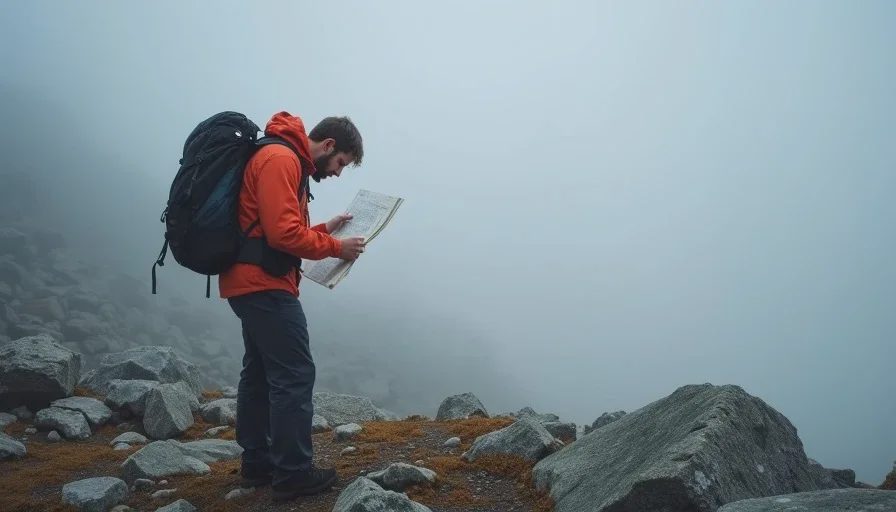
I got lost once. Properly lost — the kind where the map stops matching the ground, the phone has no signal, and the quiet voice that says "I know where I am" goes silent all at once. It happened above 12,000 feet on a route I had walked before, which is the detail that matters most. It is also the reason I now teach myself and anyone who will listen the navigation skills for backpackers that I ignored that day. This is the story of the mistake, the debrief that followed, and the system I built afterward so it never happens again.
The Day I Got Lost Above 12,000 Feet
It was not a dramatic day. That is the first thing to understand. The weather was fine, the route was familiar, and I had done this loop a dozen times. Every element of the setup that should have made the day easy was in place. Which is exactly how a person gets lost — not in the storm, but in the ordinary. The memorable failures are rarely loud.
How It Started
I was above treeline on a shoulder of the mountain, moving in and out of broken cloud. I had walked this stretch enough times that I had stopped paying attention to the ground. I trusted my feet and my memory, and the phone in my pocket with the map cached and the battery at eighty percent. Somewhere in the afternoon the cloud closed in. Visibility dropped to maybe forty feet. The wind came up. The trail — which I had assumed was obvious — dissolved into a field of identical boulders and low hummocks. Twenty minutes later I was not sure which way I had come, and I had no way to prove any of my guesses.
What Actually Went Wrong
The honest debrief came later, sitting at the kitchen table with Thea, and it had four parts:
I trusted familiarity instead of the map. Confidence in a route is not a navigation tool.
I had one source of truth. The phone was my only map, and the moment I could not confirm position, I had nothing.
I had no habit of fixing my position continuously. I did not know the last place I had been certain of, because I had not been checking.
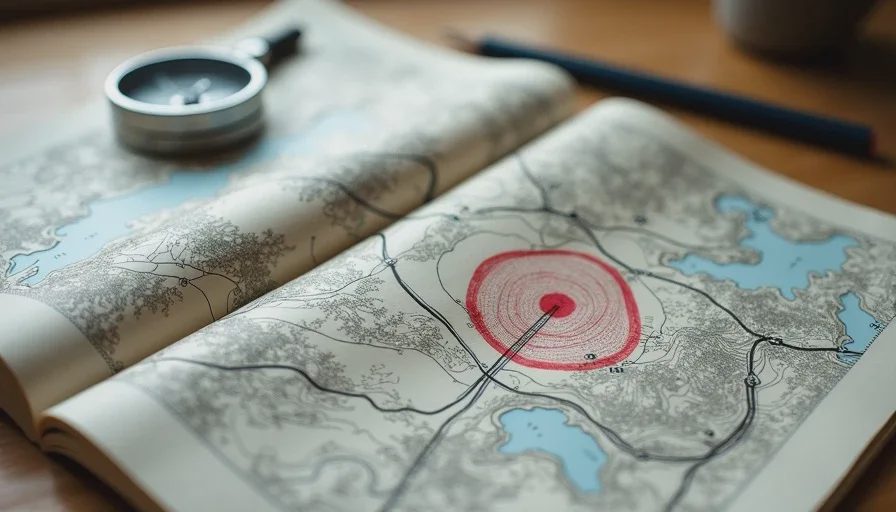
I had no printed bailout. When the phone and the memory both failed, there was no plan written down to fall back on.
The System I Built Afterward
The fix was not one dramatic change. It was a set of small, boring habits that together make it nearly impossible for me to get lost the same way twice. None of them are clever. All of them are tested on the ground. This is the part of navigation skills for backpackers that does the actual work, and it is mostly unglamorous repetition.
The Rule of Two Truths
I never rely on one way of knowing where I am. At any point on trail, I want two independent confirmations — a map feature matched to the ground, and either a compass bearing or a recorded position that agrees with it. If the two disagree, I stop. The stopping is the skill. Walking on while the two truths disagree is how a small error becomes a lost afternoon. Since I started this rule, I have stopped three times, and all three stops were correct.
The Hourly Fix
Every hour on the move, I take one minute and answer the same three questions, out loud or in my head:
Where was I certain of my position an hour ago?
What does the ground around me match on the map?
If I stopped right now, could I tell someone exactly where I am?
The habit is dull. That is its power. A dull minute of confirmation keeps a sharp afternoon honest, and it costs less than the water you would drink in that minute.
The error-to-fix table, for the record:
The error | The fix |
|---|---|
Trusted familiarity | Treat every route as unfamiliar until proven otherwise |
One source of truth | Phone, map, and compass — two independent confirmations minimum |
No continuous position fixing | The hourly three-question check |
No written bailout | A paper card with bearings, distances, and exit options |
What the Mistake Left Behind
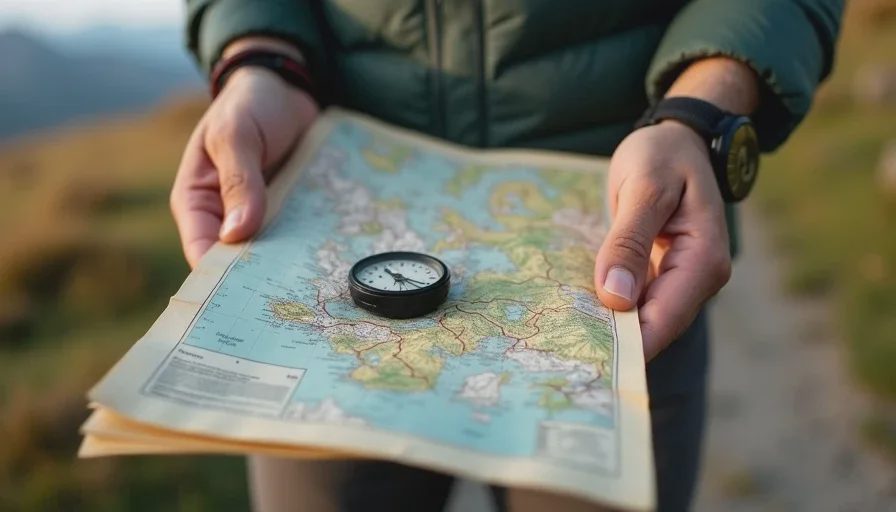
That afternoon cost me a cold night, a long walk out in the dark, a worried partner, and a week of replaying the sequence in my head. What it gave me was better than any of it. It gave me the humility that navigation actually runs on. I signed up for formal navigation training the next spring, and the classroom hours mattered less than the habit they forced into my navigation skills for backpackers practice: practice with the compass until it is muscle memory, in town, on short walks, in the park. You do not learn a bearing in an emergency. You recall it.
I still carry a paper map and a real compass on every trip, including the ones I have walked a dozen times. It costs ninety grams and it has never once failed me. That is a trade I will make every season. The phone comes along, charged and cached and quietly demoted to a backup role, which is the role a tool should have. The map does not blink, and the compass does not update. That is exactly why I trust them.
One steady step — checked against the ground, confirmed against the map, and taken with the full knowledge that the ground is allowed to surprise me.



No comments yet — grab the first one.