
The books I read between trips do more for my mental preparation for long distance hiking than any training hike or gear shakedown. That is not a metaphor. It is a practical observation about what happens to your mind on the fourth day of a solo section hike, when the novelty has worn off and the trail has become a rhythm of walking, eating, sleeping, and walking again. The interior landscape — the one you carry in your head, shaped by what you have read and what you remember — is the terrain that matters most when the physical terrain becomes routine.
The Winter Canon
When the high country is under snow and the trails below are frozen mud, I read. Not gear blogs or route reports — those I consume year-round — but the books that form my internal trail library. These are the texts I return to, not because they are canonical in any academic sense, but because they describe something I recognize from my own miles. They are, in their way, a form of mental preparation for long distance hiking that no training plan can replicate.
The Core Shelf
Book | Author | What It Gave Me | When I Re-read It |
|---|---|---|---|
Desert Solitaire | Edward Abbey | Permission to be angry about what is being lost | Every winter |
My First Summer in the Sierra | John Muir | A model for sustained, joyful attention | Before long section hikes |
Wild | Cheryl Strayed | Honesty about what a trail cannot fix | When I feel too competent |
The Snow Leopard | Peter Matthiessen | The discipline of not arriving | Before high-altitude trips |
A Walk in the Woods | Bill Bryson | Permission to be ridiculous | When I take myself too seriously |
Abbey is the one I argue with. He is cranky, contradictory, and sometimes wrong, and reading him in winter is like sitting across from a friend who has had two beers too many and is telling you exactly what he thinks about the world. I do not always agree. But he makes me sharper — more willing to name what I see, less willing to accept the sanitized version of wildness that gets sold in glossy magazines.
Muir is the opposite. He writes with a joy that borders on mania, and on the trail, when I am tired and the view is just another view, I reach for the memory of his attention. He would have noticed the lichen. He would have spent twenty minutes on the lichen. That is the voice I want in my head when my own attention starts to narrow to the trail tread and the next mile marker.

What I Carry on the Trail
I do not carry physical books on the trail. A paperback weighs 6 to 12 ounces, and I have spent too many hours trimming grams from my pack to justify that weight. What I carry instead is the residue — the passages and images that have lodged in my memory and surface unbidden at the right moments. This residue, built over years of winter reading, is the quietest form of mental preparation for long distance hiking I know.
What Surfaces and When
On the third morning of a solo trip, when the solitude has shifted from luxury to weight: Cheryl Strayed's honesty about how the trail does not fix you. It just gives you a place to sit with what is broken.
At a high pass in wind, when the exposure tightens something in my chest: Matthiessen writing about altitude and acceptance. Not conquering the mountain. Accepting it.
When I find trash at a campsite: Abbey's fury, transmuted into my own quiet anger, which I then transmute into picking up the trash and carrying it out.
When the weather turns and I have to turn around: Muir, who turned around plenty. His joy was not in summiting. It was in being there.
One steady step. That is what all these writers are saying, in their different voices, from their different decades. The trail is not a destination. It is a practice. You walk. You pay attention. You keep walking. The books are just other people's field notes, written in a different medium, about the same thing.
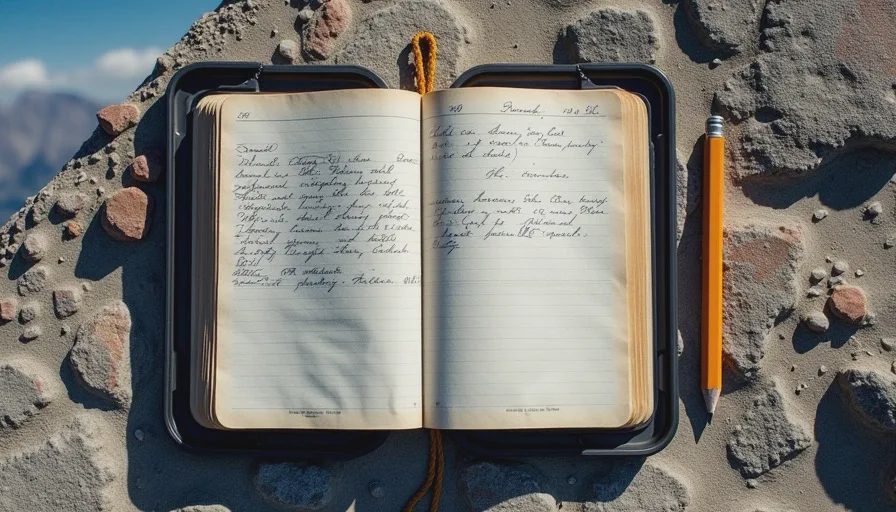
The Trail Logs That Are Not Books
The texts that have shaped me most are not published. They are the trail registers — the notebooks in plastic boxes at passes and summits, the faded entries in trailhead kiosks, the names and dates and brief conditions reports that strangers leave for strangers. I have read hundreds of these entries, and I have written in dozens.
They are not literature. They are better than literature, in a way, because they are immediate and unselfconscious. "Rainy. Saw a marmot. Tired but good." That is a complete emotional arc in six words. "Turned around at the lake. Too much snow above 11,500." That is a decision-making framework in eleven words. These entries have taught me as much about mental preparation for long distance hiking as any published author, because they are written by people who are in the middle of it — not reflecting afterward, not crafting a narrative, just recording what is in front of them while their hands are cold and their boots are wet.
In winter, when I cannot be on the trail, I sometimes pull out my own field notebooks and read them. They are less articulate than the published books on my shelf, and more honest. "Day 3. Wind all night. Slept poorly. Oatmeal tasted like nothing. Walked 14 miles anyway. Felt better by mile 10." That is the truth of long-distance hiking — not the epiphany, not the transformation, but the walking. The ordinary, unglamorous, persistent walking that carries you from one place to another, one steady step at a time.

No comments yet — grab the first one.