
The Contax T2 sat on the tent floor between my boots, fogging slightly in the cold. I've carried it on most of my trips for the past six years, and it's the answer I give when people ask about film photography outdoors — not because film is nostalgic, but because it changes the shape of a day on trail. With a screen in my hand, I photograph what I think I'll want to remember. With this camera, I photograph what I'm actually looking at.
Why I Carry a Camera at All
I don't photograph a trip to prove it happened. I photograph to slow it down, and film is the slowest tool I own. Thirty-six exposures instead of a thousand means I pick every frame before I take it, and most of the pictures I keep were ones I stood still for a long moment before pressing the shutter. The camera is a small, quiet discipline that has taught me more about paying attention than any book I've read on the subject.
Thirty-Six Exposures, Not a Thousand
A memory card is infinite, which is exactly the problem. On a digital body I shoot in bursts and sort later, which means I'm never fully inside any single moment. On film, the roll is a bank account I budget all week. Some trips I come home with six frames I'd keep, and the whole trip still feels complete — not because the photos are anything special, but because the choosing was the point. I finished a roll once in the Indian Peaks with an entire day of lake basins still ahead of me, and that disappointment taught me to be more selective, not more prolific. Now I check the frame counter the way I check my water — deliberately, and rarely.
The Fixed Lens Is a Good Limit
The T2 has a fixed 38mm f/2.8, which is roughly what your eye sees when it's not trying hard. There's no zoom, no menu, no scene modes. I set the aperture, the camera meters, and I mostly let it be. A fixed lens means I move my feet when I want a different picture, and moving my feet is never a bad idea in the mountains. The whole kit for film photography outdoors fits in the pack lid:
One body with its fixed 38mm lens — nothing to swap, nothing to lose
Two or three rolls, wrapped against light and cold
A lens cloth in the same pocket
One spare battery for the meter
That's the entire camera bag, and it weighs less than a single telephoto.
What Film Keeps That Digital Lets Go
The pictures I keep from the mountains are never the ones I could have planned. Film catches the unremarkable minutes — the mud on a boot, the light through a tent fly at five in the morning — and renders them with a patience that digital often doesn't have time for. It's the difference between recording a day and keeping part of it.
Boot Mud and Tent Light
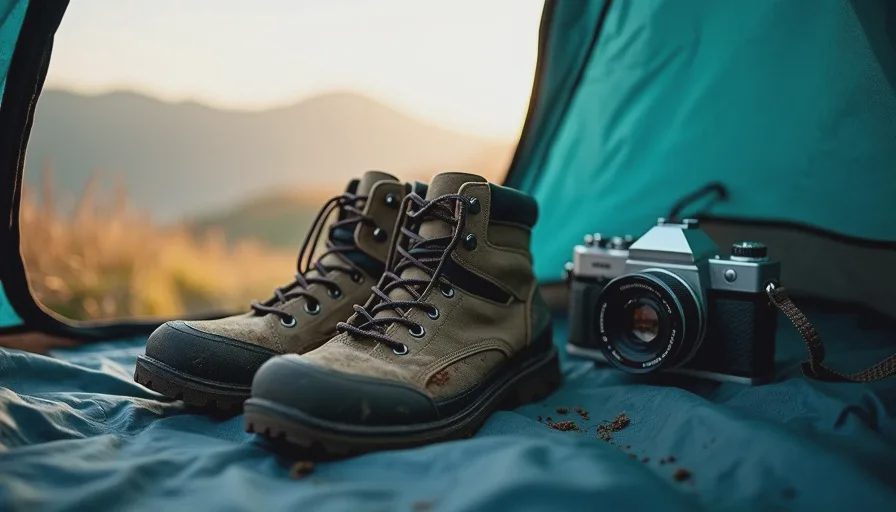
The frame I keep from last June isn't the lake basin at noon. It's the floor of the tent at 5:40 in the morning: my boots crosshatched with dried mud from the day before, the camera's titanium body in the corner, and a slice of cold blue dawn light coming through the door. On film, the blue hour holds its color; it doesn't snap to neutral. That single frame says more about that trip than any wide shot I took at midday, and I didn't know it when I pressed the shutter — I only knew it six weeks later, when the negatives came back.
The Line of Clouds at Treeline
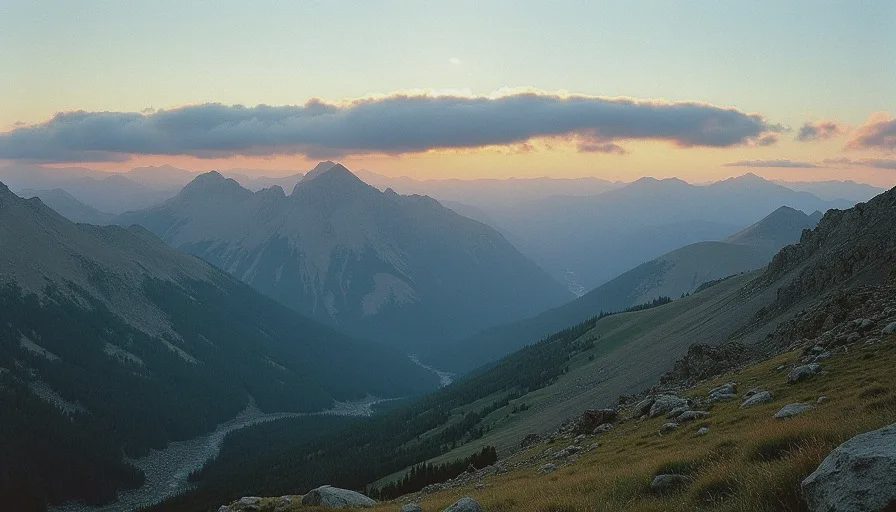
There's a photograph I've never shown anyone of a line of flat-bottomed clouds sitting just above the treeline — the kind that form when the air crosses a ridge and can't decide what to do next. I exposed for the clouds, so the hillside fell into a deep, quiet shadow. Digital would have lifted that shadow automatically and lost the mood. Film let it go dark, which is exactly how the evening felt. That's the whole argument, in one frame: the tool is honest about the hour you were actually in.
The Practical Side of Shooting Film Outdoors
Film is fussy about cold, heat, and airports, and the workarounds become part of the ritual. The short version of what I've learned:
Below freezing, keep the rolls in an inner pocket — cold makes the emulsion brittle, and I've cracked a roll loading it at five in the morning in a wind.
In summer, keep the camera out of direct sun in the pack lid, and let it come to temperature before you open the back.
At airport security, ask for a hand-check rather than send the film through the X-ray machine — it costs one extra minute and it's worth it.
Develop within a couple of months; color film doesn't wait forever.
Developing is the part people are surprised I still do myself. I develop at home — a small tank and a changing bag on the kitchen counter, which Thea has learned to work around — and I scan the negatives myself. The whole process is maybe an hour at the end of a trip, and it's the hour when I finally see what I was looking at. Some rolls are duds. The light lies, or I misjudged an exposure at a critical moment, or the wind moved the frame. That's part of the deal, which is why I never rely on a single roll for a trip I care about.
The morning coffee fits the same rhythm. I roast small batches at home and carry a handful of beans and a little hand grinder; the ritual of grinding coffee while the camera comes up to temperature is the calmest fifteen minutes of any trip. Both are slow crafts, and they keep each other company in the hour before the day gets serious.
What I keep from all of it is attention, and attention is a practice, not a possession. That, more than anything, is what film photography outdoors has given me: the habit of looking twice. One steady step. One frame at a time.



No comments yet — grab the first one.